Picture this: you’ve just finished a stunning pool terrace rendering. The client loves it. The proportions are perfect. Then the installer calls the stone format you specified means 47 grout lines across a 20-foot deck. Suddenly, “stunning” becomes “busy.” We’ve seen it happen more times than we’d like to admit.
That’s exactly why jumbo stone slabs have become the go-to choice for architects and designers working on premium Canadian projects. Whether it’s a lakeside outdoor kitchen in Muskoka, a Yorkville penthouse terrace, or a grand estate entrance in Oakville, large format natural stone slabs deliver the seamless, sculptural look that smaller formats simply can’t match and they do it while holding up to Canada’s brutal freeze-thaw winters.
In this guide, we’ll walk you through the top five reasons design professionals across Ontario keep specifying natural stone jumbo slabs and why we think it’s one of the smartest material decisions you can make right now.
1. Seamless Aesthetics That Elevate Any Design
There’s a reason high-end residential and commercial projects across Toronto, Ottawa, and Mississauga keep gravitating toward large format natural stone slabs. Fewer joints mean a cleaner visual field. And a cleaner visual field means your design reads exactly the way you intended it uninterrupted.
Think about it like a painting. You wouldn’t want a grid of masking tape cut across a canvas. The same logic applies to a statement patio or outdoor kitchen countertop. Jumbo slabs typically starting at 24″x48″ and going up to slab sizes of 63″x126″ or beyond let the natural veining and colour movement of the stone do the talking.
How It Reads on Site vs. On Paper
One thing we always tell architects: the scale transformation from rendering to real life is dramatic. A slab that looks “large” on a drawing reads as perfectly proportioned once it’s installed across a 400 sq ft terrace. Smaller formats? They can start to look almost tile-like at that scale fine for interiors, but rarely what a premium exterior project deserves.
From hundreds of Ontario installations we’ve handled, the projects that photograph best, win design awards, and generate the most referrals almost always feature jumbo slabs. That’s not a coincidence.
2. Superior Freeze-Thaw Performance Built for Canadian Winters
Let’s be direct: Ontario winters are not forgiving. We’re talking -30°C nights, repeated freeze-thaw cycles from November through March, and the kind of ice heave that will exploit any weakness in a paving system. Choosing the wrong stone or the wrong format can mean cracked coping, lifted pavers, and a very unhappy client by spring.
Here’s where jumbo slabs for landscaping have a real structural advantage. With fewer joints, there are fewer entry points for water. Less water infiltration means less freeze-thaw damage over time. It’s similar to choosing a high-quality winter boot with sealed seams versus one with a dozen lace holes letting moisture in the fewer the gaps, the better the performance.
What to Look for in Cold-Climate Stone
Not all natural stone handles freeze-thaw cycles equally. For Canadian projects, we consistently recommend:
- Granite: extremely low water absorption (often below 0.4%), virtually impervious to freeze-thaw damage. Our Ontario granite slabs are quarried and finished specifically for exterior Canadian applications.
- Limestone: when properly sealed and of sufficient density, performs well. Avoid highly porous varieties for exposed horizontal surfaces.
- Sandstone: select dense, tight-grained options only. Softer sandstones are beautiful but not built for Canadian exterior use.
- Travertine: use filled and honed varieties outdoors, and always specify a penetrating sealer. We’ve seen unfilled travertine hold moisture and crack within two winters.
The Natural Stone Institute publishes absorption and freeze-thaw testing standards worth referencing when specifying stone for Canadian climates, a useful resource to share with clients who want the technical assurance.
3. Faster Installation, Lower Long-Term Labour Costs
This one surprises some designers, but it matters enormously for project budgets and timelines. Jumbo slabs cover more area per piece. That sounds obvious, but the downstream effect on labour is significant.
Fewer cuts. Fewer pieces to handle, mortar, and level. Fewer joints to grout and seal. On a large pool deck or driveway installation, switching from a 12″x24″ format to a 48″x96″ jumbo slab format can cut installation time by 30–40%. In today’s labour market where skilled stone installers in Ontario are genuinely hard to find and expensive to book, that’s not a small thing.
The Hidden Cost of Small Format Stone on Big Projects
We had a client in Burlington last year, a designer specifying a 600 sq ft outdoor kitchen and dining terrace. The initial quote came in with a mid-size porcelain format. Labour alone was going to run close to $28,000. We shifted the specification to a large format natural stone slab in a gauged granite finish with fewer pieces, cleaner layout, and labour dropped by nearly $7,000. The stone itself cost more per sq ft, but the total installed cost was lower, and the result was dramatically better. That’s the conversation worth having with your clients early.
4. Design Versatility Across Applications
Jumbo slabs for outdoor kitchens, pool surrounds, feature walls, driveways, and grand entrances the applications are genuinely wide. What makes them so adaptable is that a single slab format can carry through multiple zones of a project, creating visual continuity that’s very hard to achieve with smaller formats or mixed materials.
Common Design Applications We See in Ontario
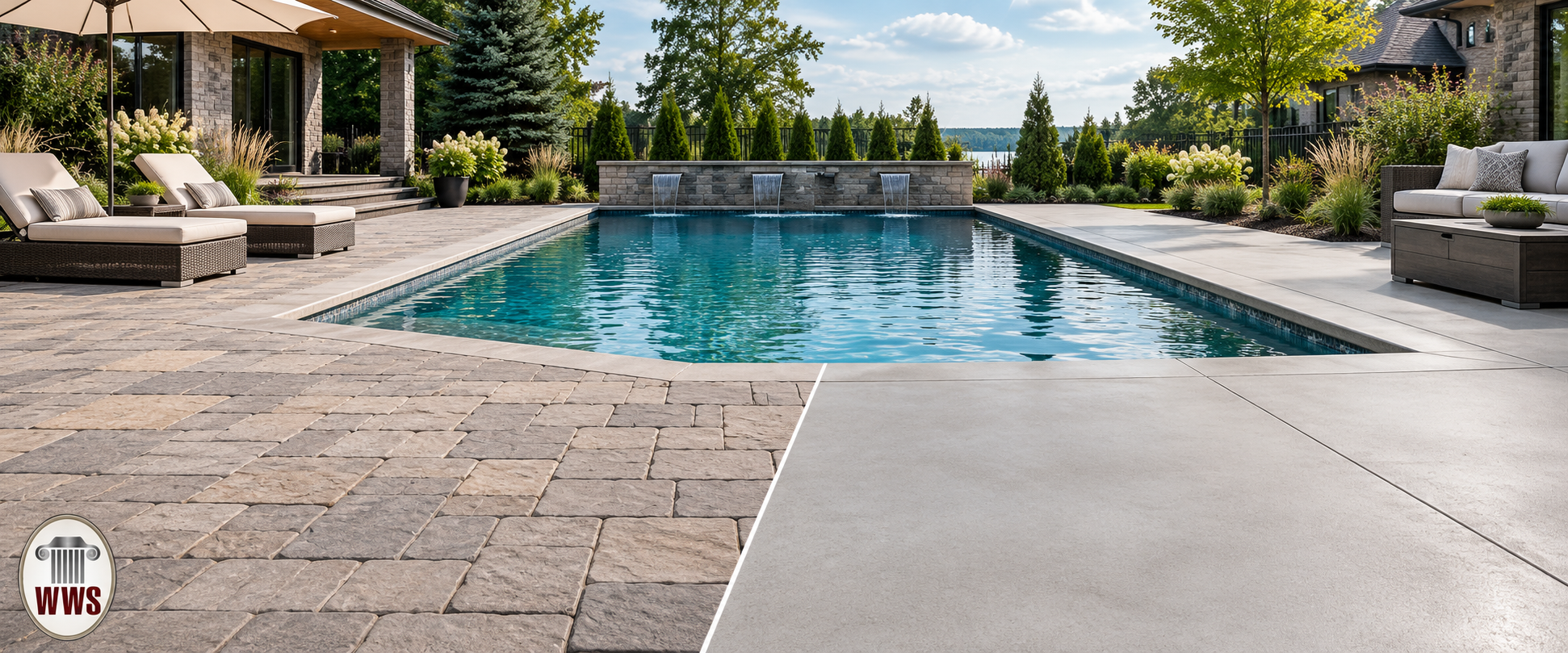
- Pool coping and decking continuous slab edges eliminate the grout-line water traps that plague modular coping. Honestly, we’ve seen too many concrete copings crack after one bad winter. Natural stone, specified and installed correctly, simply outlasts everything else.
- Outdoor kitchen countertops and island’s large slabs mean uninterrupted work surfaces and dramatic book-matched patterns if you want them.
- Driveway aprons and entrance features a 60″x120″ granite slab set into an entry drive makes an immediate architectural statement.
- Feature and accent walls thin-gauged jumbo slabs (as slim as 1 cm) bring the same large-format drama to vertical surfaces
- Commercial terraces and rooftop amenities are increasingly popular in Toronto’s condo and mixed-use developments where outdoor amenity space is a major selling point.
Invest once in natural stone, enjoy your elegant driveways for decades.
For a closer look at how we’ve used large format stone across Ontario pool and patio projects, our project gallery is worth a browse.
5. Ethical Sourcing and Traceability A Growing Client Priority
This is a reason that’s moved up the list fast over the past few years, and it reflects a real shift in how architects and their clients think about materials.
More and more, design professionals are being asked: where did this stone come from, and how was it extracted? It’s a fair question. The natural stone industry has a complex global supply chain, and not all suppliers can answer it clearly.
At Worldwide Stone, traceability is something we take seriously. We work directly with quarries across India, Brazil, Portugal, Turkey, and beyond and we vet our partners for responsible extraction practices, fair labour standards, and environmental compliance. When you specify stone through worldwidestone.ca, you can tell your client exactly where it came from. That matters for LEED documentation, for ESG-conscious clients, and honestly, just because it’s the right thing to do.
The Natural Stone Institute’s Sustainability Initiative is a solid external reference for clients who want to understand responsible sourcing benchmarks in the industry.
Practical Tips and Mistakes to Avoid
A few things we’ve learned the hard way, so you don’t have to:
- Do specify frost-resistant, low-absorption stone for any exposed horizontal surface in Canada. Test data matters here and ask your supplier for it.
- Don’t specify highly polished finishes for pool decks or driveways. Wet polish and ice are a liability issue. Specify flamed, brushed, or sandblasted finishes for slip resistance.
- Do account for slab weight in your structural and substrate planning early. A 63″x126″ granite slab can weigh 400+ lbs. Your base prep and installation crew need to be planned accordingly.
- Don’t skip the expansion joint planning on large installations. Thermal movement is real, especially with the temperature swings Ontario sees. Even the best stone will telegraph stress if the installation system doesn’t accommodate movement.
- Do ask about lead times early. Jumbo slabs are not off-the-shelf items. Premium material from ethical global quarries often has 8–14 week lead times. Build that into your project schedule.
The Bottom Line
Jumbo stone slabs aren’t just a design trend. They’re a practical, long-term solution for architects and designers who want their Ontario projects to look stunning on day one and hold up through decade after decade of Canadian winters. Fewer joints, better performance, faster installation, incredible visual impact, and increasingly, a story your client can feel good about.
We’ve been supplying and specifying natural stone for Ontario projects for over 20 years. We’ve seen what lasts and what doesn’t. And when a client wants something that genuinely stands the test of time in aesthetics and in Canadian weather, jumbo slabs are almost always the answer.
Ready to specify for your next project? Reach out to our team at WorldWide Stone for material samples, project consultation, and a free quote. We’d love to see what you’re building.
Frequently Asked Questions
Q1: What sizes are considered "jumbo" in natural stone slabs?
Generally, slabs 24″x48″ and larger are considered large format, with true jumbo slabs starting around 48″x96″ or 60″x120″. Some quarries now offer slabs up to 63″x126″ and beyond. Size availability varies by stone type and quarry.
Q2: Are jumbo slabs more expensive than smaller formats?
The material cost per sq ft is often similar or moderately higher but installed cost can actually be lower due to reduced labour. For premium projects, the better question is total cost of ownership, including longevity and maintenance over 20–30 years.
Q3: Can jumbo slabs be used for pool coping in Ontario?
Absolutely, and we’d argue they’re the best option. Fewer joints mean less water infiltration and better freeze-thaw performance. Granite and dense limestone are our top recommendations for Ontario pool applications. See our pool coping options here.
Q4: How do I ensure the stone I specify is ethically sourced?
Ask your supplier directly for quarry-of-origin documentation and any third-party certifications. At Worldwide Stone, we can provide sourcing documentation for all our natural stone products. The Natural Stone Institute also offers a chain-of-custody certification program worth referencing.
Q5: What's the best finish for outdoor jumbo slabs in Canada?
For horizontal surfaces (patios, pool decks, driveways): flamed, brushed, or sandblasted finishes for grip and freeze-thaw durability. For vertical applications or sheltered areas: honed or leathered finishes work beautifully. Avoid polished finishes outdoors unless the surface is fully covered and protected from moisture.