Canada has a way of humbling even the most well-built driveways.
In one season everything looks perfect. By the next, everyone chiseling ice at the end of the driveway, piling salt by the garage door. Or, they hope the snowplow didn’t leave another frozen wall behind the car.
Detailing with this routine in different weather isn’t easy. That’s why many Canadian homeowners start wondering what can fit in their problems. To resolve shovels, salt, and sheer patience.
Exactly here heated driveways start to enter the conversation.
In the sections ahead, we’ll break down how heated driveways work. Which natural stones perform best in Canada’s climate. What can cause the trade-offs worth.
Let’s dive deep to gain better understanding before making the investment.
What Is a Heated Driveway and How Does It Work?
A heated or often called radiant driveway is an outdoor snow melting system. By using the radiant heat generated beneath the surface, it prevents accumulating snow or ice on the surface. Built on asphalt, concrete, or natural stone pavers, this system suppresses struggling with de-icing salts, snowpolling, or shoveling.
Here’s how does it work:
1. Hydronic (Water-Based) Systems
Hydronic system is a wide network of flexible polymer tubing (PEX). It’s installed beneath the pavement. Generally, a boiler, powered by gas, oil, or electricity, circulating heated water mixed with antifreeze solution through the tubes to warm the surface.
- This system is worth lower long-term operating costs. If you’ve larger driveways, you can prefer hydronic systems. Because once they’re running, they tend to be more efficient over time. And, this efficiency matters.
- If the driveway covers a lot of square footage such as rural homes, estate properties, or circular entryways, hydronic systems usually handle the scale better than electric ones.
- Installing the hydronic system alone often runs around $15–$25 per sq. ft. before the driveway surface is even added. The system also requires a boiler and mechanical setup, which adds to the initial investment.
2. Electric Radiant Systems
A grid of specialized heating cables is embedded beneath the curb driveway surface. When activated, electricity flows through these resistive cables, converting electrical energy into heat that radiates upward to melt snow on contact.
- Electric systems are generally simpler for contractors to install, especially during driveway upgrades or smaller residential builds.
- Everything runs through electrical heating cables, so homeowners don’t need a separate boiler or mechanical room.
- While the installation is simpler, electricity can be more expensive to run over long periods, particularly for larger driveways.
In our experience across Canadian projects, most residential heated driveways under 1,000 sq. ft. use electric systems; they’re simpler and cost-effective at that scale. For long rural driveways or circular entryways, hydronic wins on long-term operating cost. |
Both systems share one critical requirement: the surface material must conduct and retain heat well, survive expansion and contraction cycles, and resist moisture intrusion. This is exactly where your stone choice matters enormously.
Natural Stone on Heated Driveways`
Not all stone is created equally suited, especially in Canada’s climate. While the temperature can go up at +30°C in July, it can drop at -35°C in January. Temperature swings make the situation really difficult to deal with.
That’s why we’ve curated a list of stones and how they perform. One more thing, at Worldwide Stone, we supply them all. Now, let’s have a look at stone specific performances:
Granite
On one hand, Granite handles rapid heat-up cycles without cracking. On the other hand, its tight crystal structure ensures water doesn’t penetrate deep enough to freeze and fracture the stone.
Usually granite based heated driveways performance up to the mark, as its
- Water absorption rate is 0.1–0.5% (≤0.5% for exterior use)
- Freeze-thaw resistance very good
- Heat conductivity is usually better
- Slip resistance is moderate
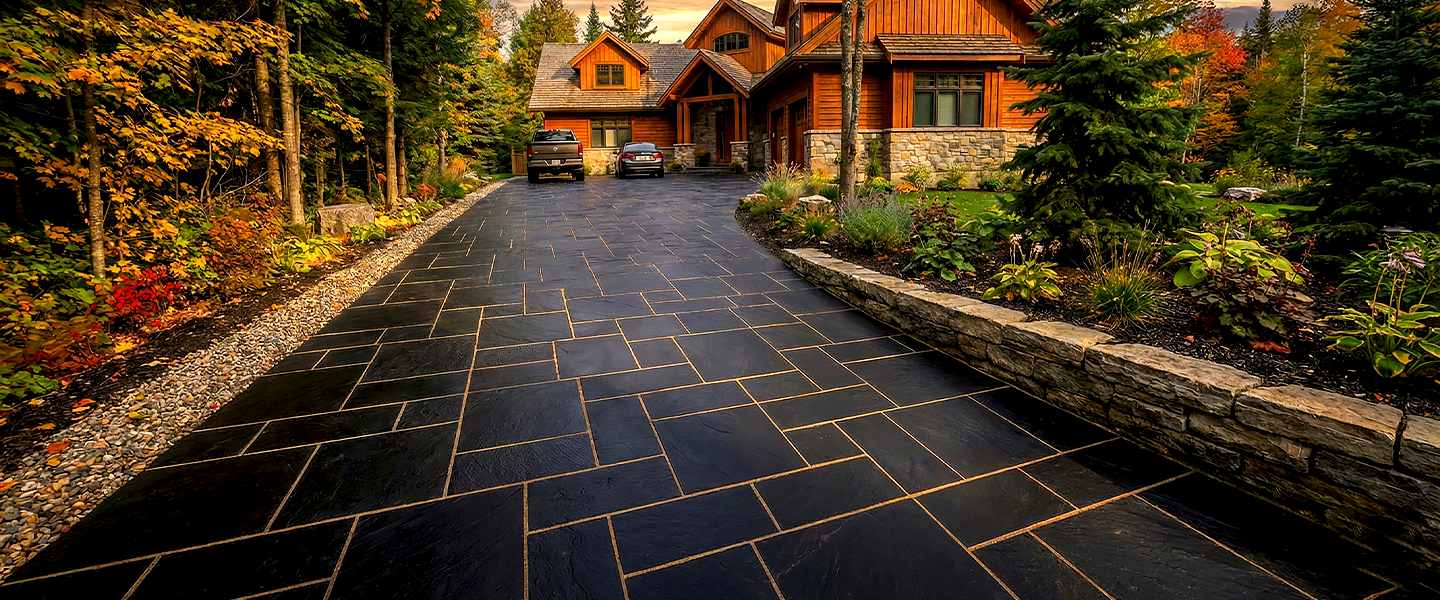
You won’t believe that our Silver Grey driveway stone is one of the most popular choices for heated driveways. Antique Black driveway stone is also popular due to its high contrast finish against snowy landscape. The color of it neither fades, nor it needs deep cleansing and daily maintenance.
Limestone
Limestone is also a popular choice among natural stone wall coping in heated driveways.
Why? The first and obvious thing is that it performs excellently as a heat accumulator and insulator. It’s highly resistant to freeze-thaw cycles. and , most importantly, it’s easy to cut to provide you with versatile shapes.
However, you can enhance its performance by maintaining the right grade and penetrating sealing protocol, usually every 1-2 years. Generally, dense, honed limestone sealed annually can perform adequately on heated driveways. Remember, softer grades of limestone are not built to survive for a high-traffic driveway.
Travertine
Travertine is stunning in pools and patios. Its characteristic voids and relatively high porosity (3–8%) make it a risk on any surface exposed to freeze-thaw. On a heated driveway? Honestly, we don’t recommend too much moisture infiltration risk even with filling and sealing.
That said, filled-and-honed travertine has been used successfully in covered entryways or porticos where it’s not fully exposed to precipitation. But for an open driveway in Ontario, choose granite.
Sandstone
Natural sandstone varies wildly in density but all comes with high porosity and higher water absorption rate than other natural stones. But they can differ in their performance.
For example, sandstones, like Kota Black, are dense enough. It performs well in outdoor spaces. In contrast, higher porosity sandstones are not suitable for heated driveways.
So, if you’re drawn to the look of sandstone, ensure asking your supplier about sandstones’ specific absorption rate and compressive strength.
Stone vs. Asphalt vs. Concrete: Honest Comparison for Heated Driveways
Here’s where we give you the real picture including where stone doesn’t win.
Criterion | Natural Stone (Granite) | Concrete | Asphalt |
Heat compatibility | Excellent dense stone distributes warmth evenly | Good but prone to cracking with thermal cycles | Fair degrades faster under sustained heat |
Freeze-thaw durability | Superior (granite: 0.1–0.5% absorption) | Moderate salts accelerate surface spalling | Poor softens in summer, cracks in winter |
Upfront cost (installed) | $30–$80/sq. ft. | $12–$20/sq. ft. | $6–$12/sq. ft. |
Lifespan (Ontario climate) | 50–100+ years | 20–40 years | 10–20 years |
Maintenance | Low seal every 2–5 years | Moderate crack sealing, resurfacing | High resealing, patching every 3–5 yrs |
Aesthetic appeal | Premium unique, natural beauty | Clean but generic | Utilitarian |
Environmental footprint | Low if ethically sourced (see Worldwide Stone’s sourcing) | Moderate cement production is carbon-heavy | High petroleum-based, non-recyclable |
Repairability | Individual slabs replaceable | Difficult patch marks visible | Patches visible; full reseal needed |
For a 750 sq. ft. driveway, expect an all-in investment of $41,000–$105,000 depending on stone and system choice. That sounds like a lot until you calculate that you won’t resurface it for 50 years, and your home’s street appeal increases substantially. We’ve had clients tell us their real estate agent credited the stone driveway directly in the listing valuation. |
Installation: What You Need to Get Right
This is where most DIY or cut-rate installs go wrong. A heated stone driveway is only as good as the system underneath it. Here’s what proper installation looks like:
Subbase requirements:
- Minimum 8–12″ compacted granular A base for Ontario frost depth
- Proper slope for drainage: minimum 1–2% grade away from the home
- Sand setting bed for natural stone pavers: 1″ screeded layer
- For rigid slab installs: reinforced concrete base with expansion joints
Heating system installation:
The heating cables or PEX tubing go down after the subbase is prepared, before the stone is set. Correct depth varies by system typically 1.5–3″ below the finished surface for electric cables. You can use a GFCI-protected circuit for electric systems. In Ontario, all radiant driveway installations require a licensed electrician for final connection.
Stone setting and jointing:
Natural stone pavers are set on a sand bed with tight joints. For heated driveways, you can use a polymer-modified jointing sand that handles thermal expansion without washing out. Additionally, avoid rigid epoxy grouts on natural stone driveway pavers. They don’t allow the micro-movement that freeze-thaw cycles create.
Maintenance: What Stone Actually Needs
#1. Sealing: A penetrating silane-siloxane sealer is what we always recommend. Granite needs to be re-seal every 3-5 years, while limestone requires a 1-2 year cycle. One thing to keep in mind: never use topical or film-forming sealers. These can create moisture buildup and are not compatible with the heating and cooling process.
#2. Cleaning: An occasional pressure wash is all that’s required to keep the surface looking like new. If there are any stains, a mild alkaline stone cleaner is what you can use. For winter traction, you can use sand, kitty litter, or calcium chloride. But never use rock salt (sodium chloride) on natural stone surfaces to prevent damage.
#3. Inspection: Each spring, it’s worth doing a quick walkaround of the driveway edges and joints. Check the expansion joints and perimeter areas, and if the jointing sand has shifted during winter freeze-thaw cycles, simply reapply or repoint it before the next season.
#4. Heating system check: Before the first snowfall of the year, most installers recommend running a pre-season system test. Many electric systems include a simple resistance test protocol that confirms the cables are functioning properly. Catching an issue early is much easier than discovering it during the first major snowstorm.
Alternative Surface Options and When to Choose Them
Beyond natural stones, you can consider alternatives. Here’s which they are:
Porcelain Tile for Driveways
High-quality large-format outdoor tile installation using porcelain tile sizes & formats of 20mm+ thickness is an excellent option for heated driveways. Porcelain is non-porous (water absorption <0.1%), available in large formats that reduce joints, and often more affordable than premium natural stone.
We usually recommend it when clients want a very contemporary look with guaranteed freeze-thaw performance. You can check our outdoor stone & porcelain options for heated surfaces.
Exposed Aggregate Concrete
If budget is the primary constraint, exposed aggregate concrete over an electric mat is a legitimate approach. It’s not as durable as granite, but it performs better than plain concrete due to its textured, porous-resistant surface. Expect a 20–30 year lifespan with proper maintenance in Ontario conditions.
Permeable Pavers
If drainage is your concern in driveways, you can consider permeable concrete or natural stone pavers. However, its open-jointed structure makes it incompatible with most in-slab heating systems. Usually, the heat dissolves through the joints before reaching the surface effectively.
Wrapping Up!
Heated driveways can be the smartest investments for you, if you’re targeting long haul. However, not every other stone can set the long-term beneficial bar. Additionally, their installation and maintenance elevate your budget.
Worry not! When you’re looking for the right system and trusted contractor – who not just solve your problem but provide the right knowledge to deal with. You can anytime book your free consultation with WordWide Stone. Let’s make your project in a way that you hardly need a 7 a.m. shovelling session again.
Frequently Asked Questions
Q1: Can you use any natural stone on a heated driveway?
No. Dense, low-porosity stones like granite (water absorption ≤0.5%) and quality sandstone are ideal. Travertine, softer limestones, and high-porosity materials are risky. Always ask for the stone’s ASTM C97 water absorption test result before committing.
Q2: Will the heating system crack my stone driveway?
Not if installed correctly. The risk comes from improper expansion joints and oversized heating systems that heat the surface too rapidly. A properly designed system warms the surface gradually and evenly which natural stone handles without issue.
Q3: How much does a heated driveway cost in Ontario?
Realistically, $55–$140/sq. ft. all-in for a natural stone heated driveway, depending on stone selection and heating system type. Electric systems start lower; hydronic costs more upfront but saves on operating costs at scale. See our full breakdown above.
Q4: Is natural stone slippery in winter even with heating?
Polished finishes can be slippery when wet. For driveways, always specify a flamed, bush-hammered, or sandblasted finish. These add texture that dramatically improves slip resistance. Our natural stone landscape products Ontario are available in multiple finishes for exactly this reason.
Q5: Do I need to seal my stone driveway differently because of the heating system?
Yes, slightly. Use a breathable penetrating sealer (silane or siloxane-based), never a film-forming sealer. Film sealers trap moisture vapour from below, which the heating system pushes upward, and eventually the sealer delaminate. Prioritize to apply sealer in the fall, after the surface has cooled down.
Q6: Where can I buy natural stone coping in Ontario for my driveway project?
Worldwide Stone supplies natural stone wall coping and driveway materials directly to Ontario homeowners, contractors, and landscapers. We import directly from ethical quarry partners worldwide, which means better quality control and pricing than most local distributors. Buy natural stone coping in Ontario or visit our showroom to see slabs in person.
Q7: What's the best stone for a driveway design in Ontario's climate?
For most Ontario homeowners, we recommend Silver Grey Granite or Antique Black Granite both available at Worldwide Stone. They’re dense enough to handle our freeze-thaw cycles, handsome year-round, and well-suited to heated systems. If you want a more contemporary or architectural look, Kota Black driveway design stone or large-format porcelain panels are excellent alternatives.