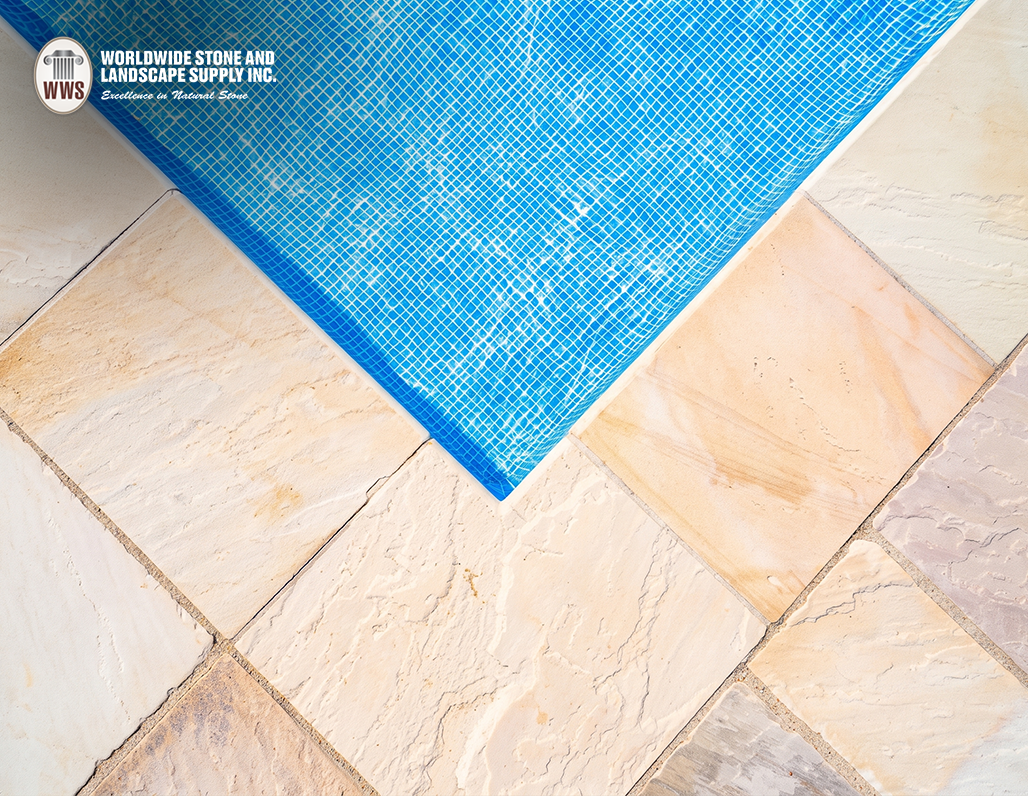
Pool corner stones are pre-cut pieces of coping that turn the corners of a pool’s edge cleanly, without awkward site-cut joints. They keep the coping profile continuous all the way around, look neater than mitred cuts and reduce cutting and waste during installation.
Corners are where pool coping is most likely to look wrong. A straight run of coping is easy; turning 90 degrees while keeping the edge profile, overhang and joint lines perfect is not. That’s why dedicated corner pieces exist.
This guide explains the types of pool corners, how they work with bullnose and rebate coping, how to measure for them and what to know before installation.
What Is a Pool Corner Stone?
A pool corner stone is a single piece of natural stone shaped to sit at a corner of the pool’s edge. It carries the same edge profile as the coping on either side, so the bullnose or rebated edge flows around the corner with no break in the line.
Our pool corner stones in Ontario are pre-cut natural stone pieces designed for exactly this job.
Why use a dedicated corner piece?
- The edge profile continues uninterrupted around the corner.
- There’s no thin, fragile mitre point to chip.
- Joint lines stay neat and symmetrical.
- Installers spend less time cutting on site.
- There’s less waste from failed cuts.
Types of Pool Corners
Corner type | Where you’ll find it | What it does |
|---|---|---|
Outside corner (90°) | Rectangular pool corners seen from the deck | Turns the coping around the outer corner of the pool |
Inside corner (90°) | L-shaped pools, step bays, notches | Turns the coping into a recess |
Radius corner | Pools with rounded corners | Follows a curved corner with a shaped piece |
Custom or angled corner | Freeform or unusual pool shapes | Cut to suit a specific angle or curve |
Rectangular pools usually need four outside corners. L-shaped pools add at least one inside corner. Pools with built-in steps or bench recesses often need extra inside and outside corners where the coping steps in and out.
Corner Stones vs Mitred Corners
Factor | Pre-cut corner stone | Mitred corner (two cut pieces) |
|---|---|---|
Look | One clean piece, continuous edge | Diagonal joint through the corner |
Strength | Solid corner | Thin points can chip |
Edge profile | Continuous around the corner | Must be matched carefully by hand |
Installation time | Faster | Slower, more precise cutting |
Waste | Low | Higher if cuts go wrong |
Mitred corners can look good when cut by a skilled installer, but a pre-cut corner removes most of the risk.
Also Read: Sharp Edge or Soft Curve? Rebate vs Bullnose Coping, Decoded
Matching Corners to Your Coping Profile
Corner stones must match the coping you use along the straight edges. The two most common profiles are:
- Bullnose: a fully rounded edge that’s comfortable on hands and legs. Our bullnose coping in Ontario comes in 12″ × 48″ pieces, 50 mm thick.
- Rebate (drop-face): a stepped front edge that makes the coping look much thicker. Our pool rebate coping stone comes in 48″ × 12″ pieces, 25–50 mm thick.
Always order corners in the same stone, finish, thickness and edge profile as the straight coping, ideally from the same batch, so colour and dimensions line up.
Choosing the Stone and Colour
The corner pieces are the most visible part of the coping, so colour matching matters:
Pool style | Stone and colour idea |
|---|---|
Modern, dark water look | Black stone, such as Kota Black pool corners |
Bright, cool deck | Light sandstone or limestone |
Warm, Mediterranean feel | Warm beige or soft pink sandstone |
Classic grey | Mid-grey sandstone or limestone |
Remember that dark stone absorbs more sun. If the coping is where people sit with bare legs, a lighter stone stays more comfortable on hot days.
Corner Planning for Different Pool Shapes
Every pool shape has its own corner layout. Use this as a starting checklist:
- Rectangle: four outside corners. The simplest layout and the easiest to keep symmetrical.
- Rectangle with Roman or corner steps: outside corners plus inside corners where the step bay cuts into the pool.
- L-shape: five outside corners and one inside corner where the two legs meet.
- Kidney or freeform: few or no square corners, but curved sections that need radius or custom-cut pieces.
- Lap pool: long straight runs with four corners, where any misalignment is very visible, so precise corners matter.
- Pool with a raised wall or spa: extra corners where coping wraps the wall or spa edge.
Sketch the pool from above and mark every corner before you order. It’s the simplest way to avoid a missing piece on installation day.
Finishes for Pool Corners
Corners are touched, sat on and walked on more than almost any other stone around a pool. A few finish tips:
Finish | Why choose it | Watch for |
|---|---|---|
Sandblasted or flamed | Good grip for wet feet | Slightly lighter, matte colour |
Honed or sawn | Smooth and comfortable to sit on | Less grip when wet |
Tumbled | Soft edges, relaxed look | Less crisp lines for modern pools |
Many homeowners choose a textured finish for the deck and a smoother finish on bullnose coping and corners, where people sit and lean.
How to Measure for Pool Corner Stones
Accurate measuring prevents gaps, overhang problems and costly re-orders:
- Count every corner. Note which are outside, inside, radius or angled.
- Measure each straight run between corners along the pool edge.
- Note the radius of any rounded corners.
- Decide the overhang you want past the pool wall; your pool builder or installer will advise.
- Measure the bond beam width (the top of the pool wall) so coping and corners sit fully supported.
- Photograph each corner and share photos and measurements with your supplier.
For freeform pools or unusual angles, custom stone fabrication can produce corners cut to your exact shape.
Installation Basics
Pool coping and corners are usually set in a mortar bed on the pool’s bond beam. Key points to discuss with your installer:
- Start at the corners. Set corner pieces first, then work the straight runs between them so cuts fall in less visible spots.
- Keep the overhang consistent around the whole pool, including corners.
- Maintain even joint widths and line up joints where possible.
- Leave an expansion joint between the coping and the pool deck so the two can move independently through freeze-thaw cycles.
- Slope slightly away from the water so splash and rain drain toward the deck, not back into the pool.
- Seal the stone if recommended, especially for salt-water pools.
Also Read: Natural Stone vs Concrete Pool Coping: What’s Best for Ontario Pools?
Pool Corners Through Ontario Winters
Corners take more stress than straight runs, because they’re exposed on two sides. Help them last:
- Close the pool with water at the recommended level so ice doesn’t press against the coping.
- Keep drainage clear around the deck so meltwater doesn’t sit under corners.
- Avoid harsh de-icers near the pool edge.
- Check joints and mortar each spring and repair small gaps before they grow.
For independent advice on caring for stone around water, the Natural Stone Institute has consumer resources on cleaning and maintenance.
Common Pool Corner Mistakes
- Mixing batches, which can leave corners a slightly different colour from the coping.
- Ordering the wrong profile, such as bullnose corners with rebate coping.
- Forgetting inside corners at steps and benches.
- Cutting straight runs first, which leaves awkward small pieces next to corners.
- Skipping the expansion joint, which can crack coping as the deck moves.
Planning a Pool Coping Project With Worldwide Stone
Corners are easiest to get right when they’re planned together with the rest of the natural stone pool coping. Send us your pool shape, measurements and photos, and contact our team for corner pieces, coping and a full quote.
Frequently Asked Questions
What is a pool corner stone?
It’s a pre-cut piece of coping that turns a corner of the pool edge while keeping the same edge profile as the straight coping.
How many corner stones does a pool need?
A rectangular pool usually needs four outside corners. L-shaped pools, steps and bench recesses add inside corners.
What is the difference between inside and outside pool corners?
An outside corner wraps around the outer corner of the pool. An inside corner turns into a recess, such as the inner angle of an L-shaped pool.
Can I mitre pool coping instead of using corner stones?
Yes, but mitred corners create a diagonal joint and thin points that can chip. Pre-cut corners give a cleaner, stronger result.
Do pool corners need to match the coping profile?
Yes. Bullnose corners go with bullnose coping and rebate corners with rebate coping, in the same stone and thickness.
Can you get corner stones for a pool with rounded corners?
Yes. Radius corners and custom pieces can be cut to follow curved or unusual shapes.
Should pool coping and corners be sealed?
Sealing is often recommended, especially for salt-water pools, to reduce staining and moisture absorption.
How much overhang should pool coping have?
It depends on the pool design. Your pool builder or installer will set the overhang, and it should stay consistent around corners.