What is the first thing every guest touches when they visit your home? Not the door handle. The steps. They carry every delivery, every snowy boot and every visitor, year after year. Get the parts and proportions right and the stairs feel effortless, look built-in and last decades. Get them wrong and you live with a toe-stubbing step forever. This guide explains how stone steps, risers and landing steps fit together, how to size them comfortably, and what Ontario winters demand, drawn from the stair projects we help homeowners and contractors plan every season.
The Parts of a Stone Staircase
Every stone staircase is built from the same three pieces.
Steps (Treads)
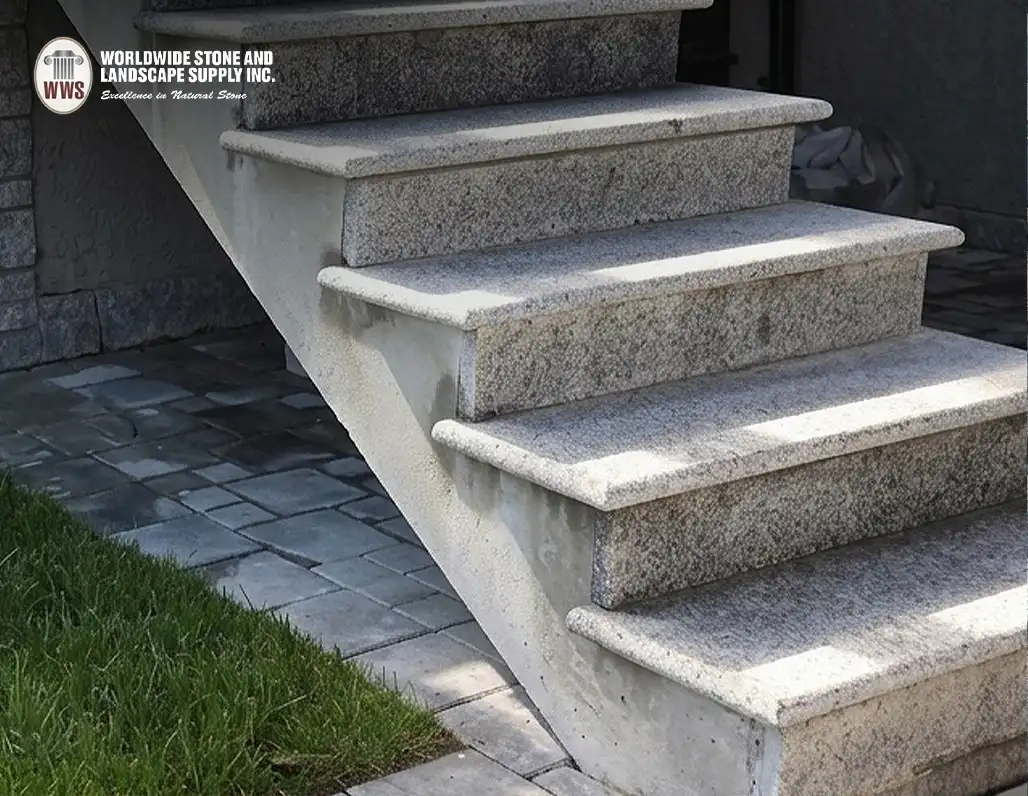
The step, or tread, is the horizontal surface you stand on. In natural stone it is a solid slab with a finished top and a front edge (the nosing). Treads carry every footstep, so thickness and a sound base matter most. Browse our natural stone steps to see the profiles and sizes available.
Risers
The riser is the vertical face between one tread and the next. It sets the height of each step and hides the base. Stone risers are thinner than treads because they carry less load. Matching natural stone risers in the same stone as the treads gives a seamless, solid appearance.
Landing Steps
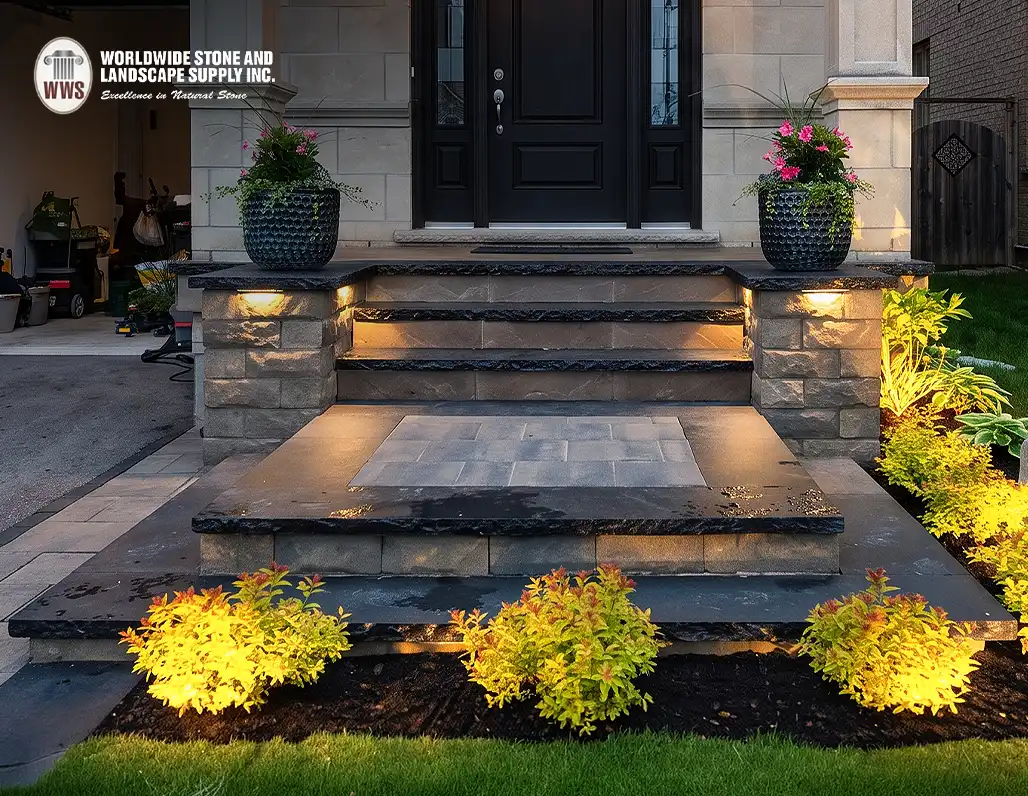
A landing step is an oversized, deeper slab that creates a flat resting area at the top, bottom or middle of a staircase. At a front door it gives you room to open a storm door without stepping backward off an edge. Our stone landing steps in Ontario are cut as single large pieces, so there are no joints where you stand most.
Solid Block Steps vs Tread-and-Riser Construction
There are two ways to build a stone staircase.
Solid block steps are single pieces of stone that form the tread and riser in one unit. They are simple to set, extremely strong and look monolithic. The trade-off is weight: each block needs equipment to place and a well-compacted base underneath.
Tread-and-riser construction uses separate pieces: a tread slab laid over a riser panel, usually on a concrete or masonry core. It is lighter, more flexible on size and the go-to choice for cladding existing concrete steps. For a crisp edge over an existing slab, rebate coping has a notched underside that wraps the top edge neatly. Edge profile changes the look and the feel underfoot, which we compare in rebate coping vs bullnose coping.
Also Read: What Are the Best Natural Stone Options for Outdoor Steps That Last in Snow and Ice?
How to Plan Comfortable Step Dimensions
Rise and Run Basics
Rise is the height of each step. Run is the horizontal distance from one nosing to the next. Outdoors, a rise of roughly 150 to 180 mm (6 to 7 inches) with a generous run feels comfortable for most people.
A common rule of thumb: twice the rise plus the run should land around 600 to 650 mm. A 160 mm rise with a 300 mm run gives 620 mm.
To plan:
- Measure the total height from the finished ground to the top surface (door sill or patio level).
- Divide by your target rise and round to a whole number of steps.
- Divide the total height by that number to get the exact rise for every step.
- Multiply the run by the number of treads to see how far the stairs project.
Keep every step identical; small differences catch feet.
Checking the Ontario Building Code and Local Permits
For private stairs serving a single home, Ontario Building Code Table 9.8.4.1 allows a rise between 125 mm and 200 mm and a run between 255 mm and 355 mm. Permit requirements vary by municipality, so call your local building department before you dig.
When Your Stairs Need a Landing Step
Add a landing step in these situations:
- At an outward-swinging or storm door, so you can open it without stepping down.
- On longer flights, to break the climb with a place to pause.
- Where the stairs change direction, since turning on a narrow tread is a common trip point.
- At the bottom, to give a clean, level transition onto the walkway or driveway.
Make the landing at least as wide as the stairs and deep enough to stand on comfortably with the door open. A single slab from our stone landing steps in Ontario range keeps it joint-free and stable.
Choosing the Stone: Granite, Limestone or Sandstone
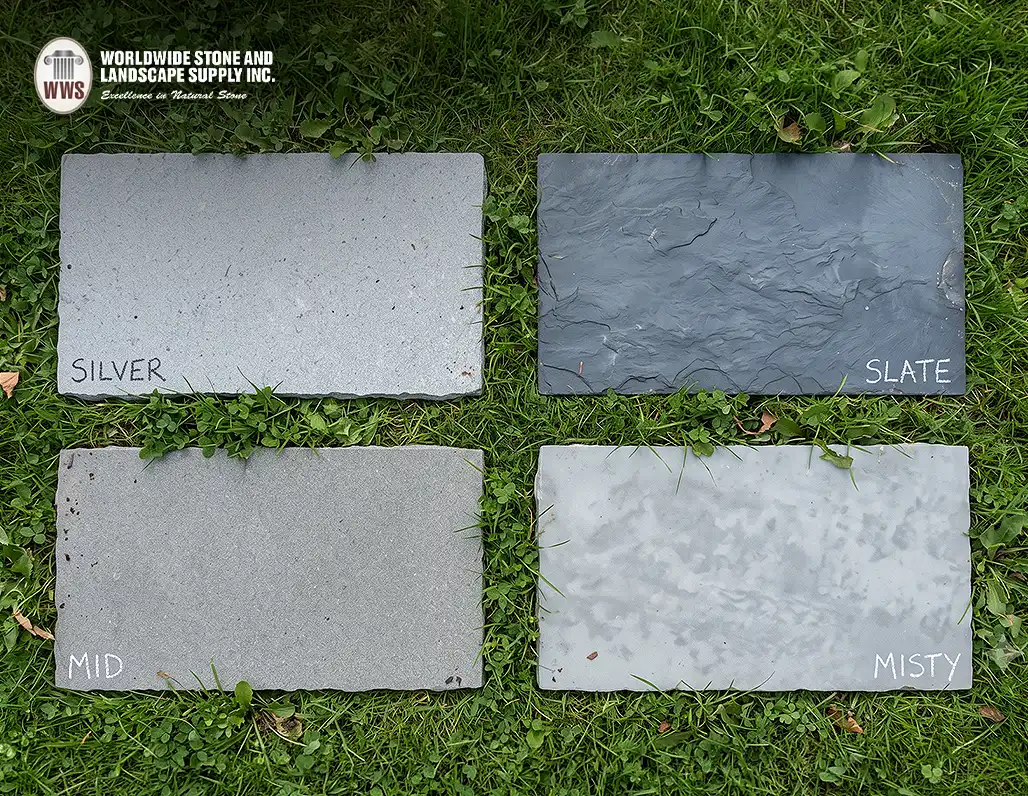
All three work outdoors in Ontario when properly installed. Granite is the hardest and most resistant to salt and wear. Limestone gives a refined, uniform look that suits traditional and modern homes. Sandstone offers warm colour variation and natural texture underfoot.
The right pick also depends on your home’s exterior. Grey granite pairs well with modern brick and black trim, while buff limestone and sandstone soften traditional facades. Whichever you choose, order treads, risers and the landing step from the same stone so colour and texture match. Density, absorption and how each handles freeze-thaw cycles all affect your choice, and we cover them stone by stone in our guide to the best natural stone for outdoor steps.
Finishes for Grip: Flamed, Sandblasted and Natural Cleft
A polished stone step is a hazard in rain or frost. Outdoor treads need texture.
Finish | How it is made | Best for |
Flamed (thermal) | High heat pops the surface crystals, leaving a rough texture | Granite steps in high-traffic, wet or icy spots |
Sandblasted | Abrasive spray creates an even, matte grip | Limestone and granite with a clean, modern look |
Natural cleft | Stone is split along its natural layers | Sandstone and slate for a rustic, uneven texture |
Whatever the finish, keep it consistent across treads and landing. For a deeper comparison of grip ratings, read our guide to non-slip natural stone finishes.
Front Entrance Steps vs Backyard and Pool Steps
Front entrance steps are about first impressions and year-round safety. They face snow, salt and constant traffic, so prioritize a durable stone, a gripping finish and a generous landing. Finishing details tie the entrance together: porch corner stones give clean returns on wrap-around steps, and natural stone pier caps crown flanking pillars. For inspiration, see our 5 modern stone entrance ideas.
Backyard and pool steps see bare feet, water and sun. Choose a lighter-coloured stone that stays cooler, a texture comfortable barefoot, and slightly lower risers for a relaxed walk down to a patio.
Also Read: Natural Stone vs. Concrete Pool Coping: What’s Best for Ontario Pools?
Installation Essentials: Base, Drainage and Frost
Stone is only as stable as what sits under it. In Ontario, the base fails long before the stone does.
- Base: Excavate to firm soil and build up compacted granular layers, or pour a reinforced concrete footing for heavier staircases.
- Drainage: Slope each tread very slightly forward so water runs off rather than pooling and freezing.
- Frost: Water trapped under steps expands when it freezes and heaves them. A free-draining base, or footings below the local frost depth, prevents shifting.
- Bedding: Set treads and risers on a full mortar bed for tread-and-riser builds; avoid spot bedding that leaves voids.
Your installer and municipality set the exact base depth for your site.
Winter Care: Salt and Snow on Stone Steps
Ontario winters test every step. A few habits keep stone looking new:
- Use de-icing salt sparingly. Sand or gentler de-icers are kinder to stone.
- Shovel with a plastic or rubber-edged blade to avoid scratching the surface.
- Rinse steps thoroughly in spring to wash out salt residue.
- Ask about a penetrating sealer for more porous stones like limestone and sandstone.
- Clear snow promptly so it does not compact into ice that needs more de-icer.
- Check joints each spring and repoint any open mortar before water gets in and freezes.
Granite shrugs off winter best, but every stone lasts longer with gentle care.
Plan Your Stone Stairs With Worldwide Stone
Bring us your measurements, a photo of your entrance or your contractor’s drawings. We will help you match natural stone steps, risers and landing steps in one stone and finish, so your staircase looks planned from the first step to the front door.
Frequently Asked Questions
What is the difference between a step and a riser?
The step (or tread) is the flat part you stand on. The riser is the vertical face between one step and the next, and it sets the height of each step.
What is a landing step?
A landing step is a larger, deeper step that creates a flat resting area at the top, bottom or middle of a staircase. It is most common at front doors, where you need room to open a door safely.
What riser height is most comfortable for outdoor steps?
Roughly 150 to 180 mm (6 to 7 inches) feels comfortable for most people outdoors. Always check the Ontario Building Code and your municipality for the exact limits that apply to your project.
Do I need a permit to build stone steps?
It depends on the height of the stairs, their location and your municipality. Contact your local building department before you start, especially for taller stairs or work attached to the house.
Should I choose solid block steps or separate treads and risers?
Solid blocks are simple, very strong and look monolithic. Separate treads and risers are lighter, more flexible on size and ideal for covering existing concrete steps.
Can stone steps go over existing concrete steps?
Often, yes, if the concrete is sound, level and not heaving. Your installer will check for cracks and movement first, then clad it with stone treads and risers.
Is de-icing salt safe on natural stone steps?
Use salt sparingly and rinse the steps well in spring. Sand or gentler de-icers are kinder to natural stone, and a plastic shovel prevents surface scratches.