Where do your eyes land when you walk up to a house? Usually the front steps, and then the corners. Those corners also take the hardest hits from rain, ice and shovels. Get them wrong and even an expensive entrance looks unfinished. So what is a porch corner stone, and does your entrance need one? This guide covers what they are, where they go, how to pick an edge profile and how to measure, drawn from the entrance projects we supply out of our Caledon Village yard. For more inspiration, see our 5 modern stone entrance ideas.
What Is a Porch Corner Stone?
A porch corner stone is a pre-made coping piece shaped to wrap the outside corner of a porch, landing or low wall. Instead of two straight pieces meeting at a cut joint, one stone turns the corner, so the edge profile runs continuously along both faces.
Our porch corner stones in Ontario are made to protect porches, parapets and low walls while giving them a finished, professional edge. [FILL: available shapes, sizes, thickness and colours from the porch corner product sheet.]
Think of it as the piece that ties straight coping, steps and landing together at the most visible point.
Why Porch Corners Matter: Looks, Safety and Weather Protection
Looks. Corners are the first edges a visitor reads. A single, solid corner piece looks deliberate; a patchwork of cut ends does not.
Safety. A continuous edge is easier to see on steps at dusk or in snow, and there is no shifting corner joint to catch toes.
Weather. Coping keeps water out of the structure beneath, and corners are where water most easily finds a gap. Fewer joints means fewer entry points for meltwater that freezes and loosens stone over an Ontario winter.
Porch Corner Stones vs Cutting Straight Coping on Site
Installers can mitre-cut two lengths of straight coping instead. It works, with trade-offs.
Pre-made porch corner | Cut from straight coping | |
Joint at the corner | None on the face; profile wraps around | Visible mitre joint |
Edge profile | Consistent on both faces | Hard to match on rounded edges |
Site work | Set and level | Measuring, cutting, dust, waste |
Weak point | Solid piece | Thin mitred tips can chip |
Profile matters most here. On our bullnose coping, we advise customers to order corner pieces rather than try to mitre-cut the rounded edge, because the curve rarely lines up cleanly.
Also Read: What Is Stone Coping and Why Is It Important for Ontario Homes?
Where Porch Corner Stones Are Used
Front Porches and Landings
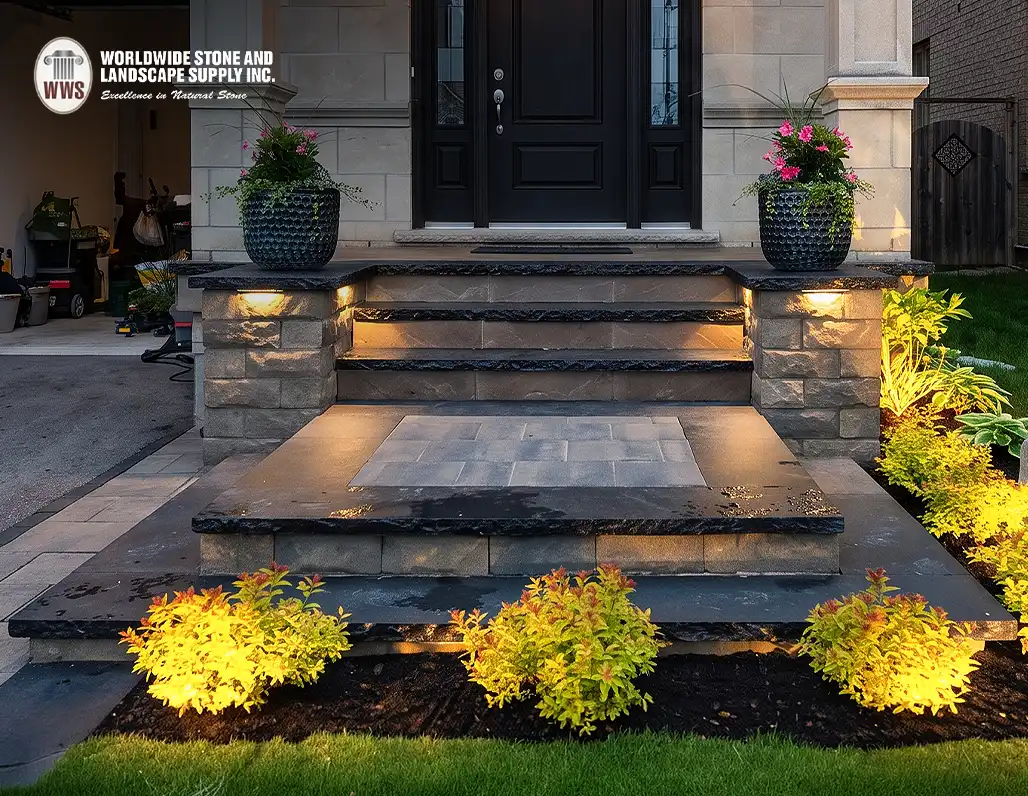
The most common job is capping the edge of a concrete porch or landing at the front door. Corner pieces finish both outside corners, then straight coping runs between them. They work well alongside our natural stone landing steps, so the landing, edge and steps all read as one stone. It is also a common way to refresh a tired concrete porch without demolishing it, provided the slab is sound.
Step Edges and Wraparound Stairs
Wraparound steps, where treads turn the corner on two or three sides, need corner pieces at each turn so the nosing stays continuous. Pair them with our natural stone steps, which are 6 to 7 inches thick, so the corner and the treads share colour and texture. Our guide to steps, risers and landing steps explains how these pieces fit together.
Raised Patios
Raised patios and low walls have the same exposed outside corners as porches. Corner pieces cap those turns, protect the wall below from water, and give the patio a clean outline.
Edge Profiles: Bullnose, Rebate and Square
The edge profile is the shape of the front face, and it sets the tone of the whole entrance.
- Bullnose: a rounded front edge that feels softer underfoot and looks refined. Our bullnose coping comes in 12″ x 48″ panels, 50mm thick, and is used on porch edges as well as pools.
- Rebate: an L-shaped, step-down profile with a 1″ exposed face and a chiselled front edge. Our rebate coping suits porch overlays where the stone laps over an existing slab.
- Square: a straight, sawn edge for crisp, modern lines.
For a deeper side-by-side, read rebate coping vs bullnose coping.
Choosing Stone and Colour to Match Your Steps
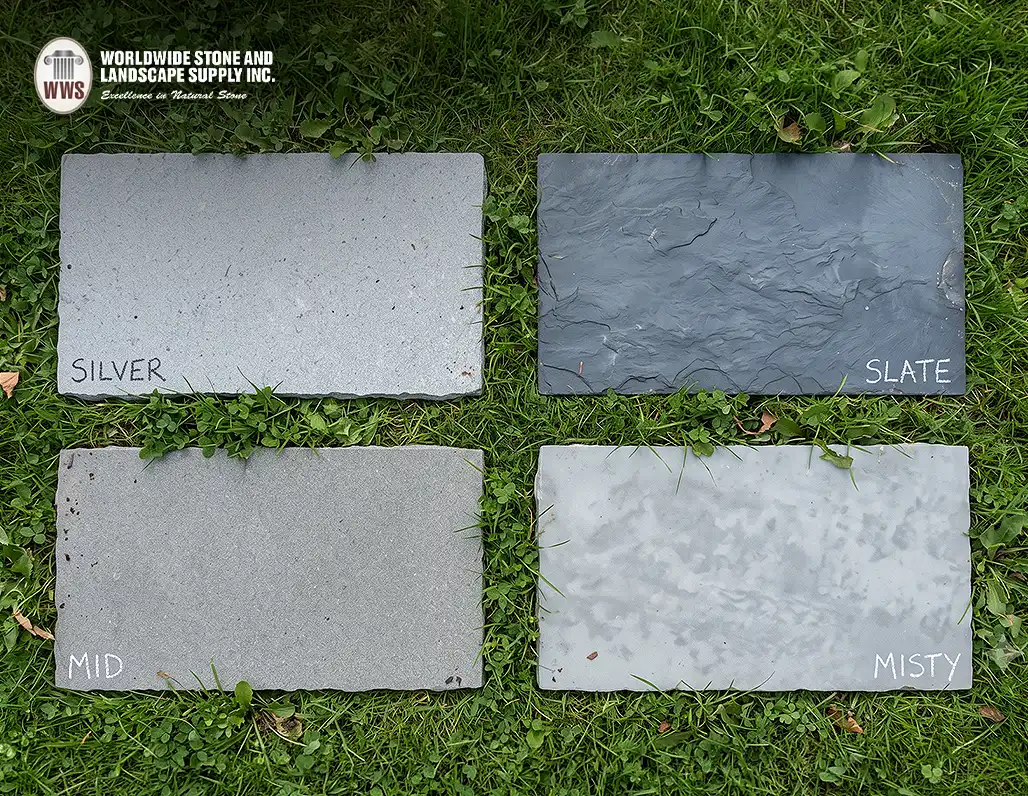
The simplest rule: corners, coping, steps and landing should be the same stone and the same edge profile. Mixing colours at the corner draws the eye to the one spot you want to look seamless.
Bring a photo of your house to the showroom and compare samples against your brick or siding. Warm brick tends to suit buff and brown sandstones; grey or white siding often pairs with greys, charcoal or black limestone.
Then carry the same stone upward. Natural stone pier caps on porch columns or railings in the matching colour finish the entrance from ground to post.
Also Read: Ultimate Guide to Natural Stone Pier Caps
Measuring and Sizing Your Porch Corners
Measure before you visit, and bring photos. A quick checklist:
- [ ] Depth of the porch or landing edge you are covering
- [ ] Overhang you want past the face (keep it consistent all round)
- [ ] Number of outside corners, plus any inside corners
- [ ] Total linear footage of straight coping between corners
- [ ] Height of the drop, for any steps or risers
For straight coping, we suggest adding about 10% for cuts and waste. [FILL: standard porch corner piece dimensions and leg lengths.] If your porch is out of square or has an unusual shape, contact our team with photos or a sketch before ordering.
Installation Tips for a Level, Well-Drained Porch
Most porch corners go onto concrete, so the base decides the result:
- Check the slab first. Coping will not fix a cracked or heaving porch. Repair movement before covering it.
- Set the corners first. Place and level each corner piece, then run straight coping out from it, so any cut lands mid-run where it is least visible.
- Build in a slight slope away from the house. Water should run off the edge, not toward the door.
- Keep joints even and fully filled. Gaps let water in to freeze.
- Dry-lay before mortaring to confirm overhang and alignment. For structural work, hire an experienced hardscape contractor.
Winter Care for Porch Stones
Entrances take more winter punishment than any patio: daily foot traffic, shovelling and de-icer tracked straight to the door.
Use a plastic shovel or one with a rubber edge so corners and nosings do not chip. Go easy on de-icer and choose a product labelled safe for natural stone; sand or grit adds traction without chemicals. Keep downspouts from dumping onto the porch, since refreezing meltwater is what loosens joints.
In spring, rinse off salt residue, look over the joints at each corner, and reseal if water no longer beads on the surface.
Upgrade Your Entrance With Worldwide Stone
Visit our showroom at 16083 Duplicate Hurontario St, Caledon Village, to see corner pieces, coping and steps together in one colour. Explore our porch corner stones in Ontario, or email info@worldwidestone.ca with your measurements and photos.
Frequently Asked Questions
What is a porch corner stone?
It is a pre-made coping piece that wraps the outside corner of a porch or landing, giving a continuous edge on both faces instead of a cut joint.
Why not just cut corners from straight coping?
You can, but pre-made corners give a cleaner joint, a consistent edge profile and less cutting and waste on site.
Should porch corners match my steps and coping?
Yes. Using the same stone and edge profile throughout gives the entrance a seamless look.
How do I measure porch corner stones?
Measure the porch edge depth and the overhang you want, count the corners, then share photos or a drawing with your supplier so pieces are sized correctly.
Can porch corners be added to an existing porch?
Often, yes, when replacing old coping or covering a sound concrete porch. Cracked or moving slabs need repair first.
Should a stone porch slope?
Yes, slightly. A gentle fall away from the house helps water drain off the edge and reduces ice build-up at the door.
Are stone porch corners slippery?
The finish matters most. Choose a textured or natural cleft finish for exterior entrances, and avoid polished surfaces where snow and rain collect.